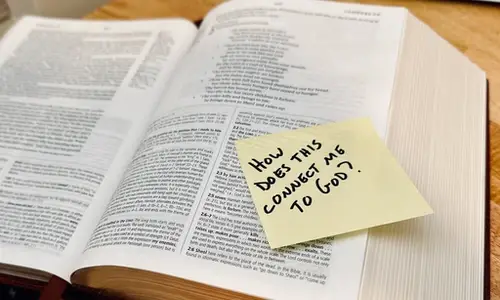
Why “Read Your Bible Every Day” Is Terrible Advice
Every year, my wife and I fly to meet my family for Christmas. They all live within driving distance of each other, and we’re across the country. It’s always a good time, full of food and togetherness and worship and presents and more food.
Christmas is a good time to kind of put the world on hold and focus on those two glorious things: Jesus and family; God and man.
A few years ago, after returning home, I was spending some time catching up on my daily Bible reading, since I had skipped several days in a row during the trip.
As I read, I suddenly realized that instead of being eager to get back into the Word, I was repeating an accusation in my head: How could I possibly ignore my devotional, during Christmas of all times?
If Christmas is a time to focus on that fulfillment of “the hopes and fears of all the years”—the resolution of the anticipation of Advent, and the restoration of the hope of Israel in the God-man Jesus Christ—then surely a pious Christian would dive even harder into Scripture during that time.
Not I.
I had neglected it. And now I was paying for it.
It was many hours later—maybe days—that I realized that that looping accusation was coming from the wrong place, generating the wrong emotion, and driving me into the wrong attitude.
Why does missing daily Scripture feel like breaking a rule?
Why This Advice Sounds So RightPermalink
Daily rhythms of Bible reading function as the default expectation in Christian community.
You don’t really hear this as a command. It’s rarely framed as law. Instead, it’s absorbed. Slowly. Through well-intentioned Bible reading plans handed out every January; through sermons that casually assume daily engagement; through small groups that begin with, “So—how did everyone do this week?”
These expectations come from good intentions. Churches and small groups like consistency; it’s better for coordination and discussion if everybody’s reading the same text at the same pace. And of course, it’s easier to publish a single schedule than it is to create one for each person.
Daily habits can indeed be helpful; productivity research shows that building habits takes a certain consistency, and losing them can happen very rapidly. Maintaining a daily schedule helps you maintain a daily schedule—which is often exactly the point.
Habits also promise relief from decision fatigue. They offer a sense of control, a way to outsource faithfulness to a system. If Scripture engagement is something you ought to do, habits feel like the responsible solution. And if your goal is consistent engagement with Scripture, the language of habit can be a helpful entry for faithful Christians looking to incorporate Scripture into their days.
To be sure, there’s nothing inherently wrong with regular practices. The history of the church, from the tabernacle onward, is full of faithful patterns woven into ordinary life. The Levitical system of priests and sacrifices assumed repeated, ongoing practices; monastic traditions have long used structured routines to cultivate holiness. These rhythms aren’t about proving private devotion but rather about ordering communal life around the presence of God.
These daily expectations aren’t limited to ancient rituals and secluded monasteries. In a more contemporary key, Tish Harrison Warren’s 2016 book Liturgy of the Ordinary baptizes the ordinary routines of our days into awareness of God’s presence.
But good intentions don’t eliminate category errors.
The Mistake: Confusing Consistency With EngagementPermalink
The real problem with “Read your Bible every day” is that it confuses consistency with engagement.
That’s what I mean by “category error”: advice built to optimize the wrong thing.
All of the science and psychology of habits is built around optimizing frequency and consistency. But Scripture is not the kind of thing that can be conquered through simple repetition. It’s a deep, complex, diverse library of books, and it rewards attention, curiosity, and re-entry over time.
Habits are excellent at producing repetition. They are much worse at producing attention.
When consistency becomes the measure, everything else is redefined around it. Faithfulness becomes something you can keep up with—or fall behind on. Engagement becomes something you can track and measure. And Scripture itself becomes a task to complete rather than a voice to listen to and an author to love.
In that framework, missing a day isn’t just a neutral absence; it feels like a failure of faith. Not because anyone said it was, but because the system has no other category for it. When consistency is the goal, inconsistency can mean only loss, and system failure becomes moral failure.
More importantly, this advice treats reading as the goal. Without a “why,” the only remaining motivation is box-checking, and Scripture itself fades into the background. Then when you inevitably miss a box, your motivation evaporates. The logic is simple and devastating: If I can’t do this faithfully, why try at all? Suddenly you’re white-knuckling your way through Scripture, which is not the way to personal formation.
As Christians, our purpose is glorifying our Creator and Savior, a life of service and worship, and the coming of His Kingdom—”to glorify God and enjoy Him forever,” as the Westminster Shorter Chatechism puts it. Scripture reading serves all those goals, but only when it’s connected to them.
When reading is its own goal, habits are hurtful, not holy.
Scripture was never meant to stand apart from the rest of Christian life. Worship, singing, listening, preaching, teaching, fellowship, and ordinary human living all matter too, as Dietrich Bonhoeffer was fond of reminding us. If you can’t say how Scripture fits into that shared life, you can’t pursue it wisely.
Framing faithfulness this way begins a cascade of consequences. Because real life is uneven: schedules break, energy fluctuates, attention wanders. And when Scripture engagement is measured by consistency and faith is measured by streak length, those ordinary human realities quickly become spiritual verdicts.
When a Habit Turns Into a VerdictPermalink
No one experiences this shift as a single dramatic moment. It happens gradually, even imperceptibly. You miss a day, or maybe several. You notice you’re behind. You feel a twinge of discomfort, then something heavier. And before you’ve consciously decided anything at all, Scripture has become associated not with invitation, but with accusation—Bible reading has turned into homework.
“Read your Bible every day” drives each of these steps, making each of them feel normal, even justified, and leaving a reader seeking to be faithful feeling like maybe the Bible is simply out of their reach.
If “daily” is the expected cadence, then missing a day does in fact put you “behind.” You were supposed to check that box, and you didn’t. If missing one day is bad, missing two days is worse. Soon, a week spent focusing on something else—even something great, like Christmas with your family—makes you feel unrecoverable. For some people, simply falling behind feels bad enough. But the cycle continues.
If “read your Bible every day” is sound advice, then that’s what “good Christians” do. So now missing that day doesn’t just put you behind, it also differentiates you from everybody else. They’re all “on track” and you’re… not. No matter how many times we read axioms like, “Comparison is the thief of joy,” we can’t help but compare ourselves to others—even if those others exist only in our imaginations. You don’t want to admit that you fell behind, so you skip your small group. Or maybe you attend, but you nod along and hope nobody asks how it went this week.
That feeling of shame is the natural next step. If daily reading is good, then missing a day is bad. You don’t want to admit you skipped Tuesday. Or Wednesday. Even if you had a long day at work on Tuesday or a school project due Wednesday. Maybe you don’t even want to admit it for yourself. It’s a lot easier to just not open the app or the spreadsheet or the list, so you don’t have to see the empty checkboxes.
Some people catch themselves here and adjust. But many don’t, and the spiral tightens. What began as a simple habit becomes a measure of worth. If you can’t keep up—Who can’t spare 15 minutes?—then maybe you’re not cut out for church. Maybe it’s only available for people with more time, or discipline, or willpower, or faith.
This conclusion feels extreme when you read it on the page, but each of these steps feels normal as you’re taking it. At no point did you consciously consider that missing a day of reading makes you un-Christian, but you’ve arrived there nonetheless.
And that’s how a scheduling tool quietly becomes a moral verdict: not in one dramatic leap, but in a series of small assumptions that each feel reasonable at the time.
Scripture Makes Room for ReturnPermalink
Fortunately, “Read your Bible every day” isn’t a Biblical instruction. The Bible does not treat interrupted engagement as unmitigated failure.
To see this truth, we can start with one of the most foundational rhythms of Scripture: Sabbath. It’s introduced in the first chapter of Genesis as a period of rest after a long period of work. A deliberate interruption in intensity; a day to remember God, not to continue your tasks unabated. Sabbath doesn’t tell us how often we should read the Bible; it demonstrates that God builds set-apart times into daily life.
Sabbath isn’t the only rhythm like this. God appointed a system of feasts and festivals every year; He required the re-reading of the law in front of the whole congregation every seven years; and He created the concept of Jubilee to release people from slavery and restore the land every fifty years. The point isn’t that daily is wrong, but that Scripture itself normalizes seasons of focus and seasons of ordinary life, without treating the latter as spiritual collapse.
Of course, Israel wasn’t always obedient; it occasionally forgot the law and strayed away from it for many years. But when the law was once again found, the response was joyful re-entry and re-discovery, not endless self-condemnation. Here are two examples.
In Nehemiah 8, the people gather together and the law is read aloud to the congregation. Levites are present to help explain the law to make sure everybody understands. The people, hearing the law and convicted by their errors, begin to weep. The leadership, including Nehemiah and Ezra, encourage them not to weep or grieve but to rejoice, because the day is holy. They don’t scold them for neglect but rather restore joy through shared understanding: “do not be grieved,” they say, “for the joy of the Lord is your strength.” They make it an occasion of merciful recovery, not permanent loss.
We see a similar pattern with King Josiah in 2 Kings 22–23. The book of the law is discovered and read aloud, and reform follows. As with Ezra and Nehemiah, the neglect was tragic. But the response to recovery is covenant renewal, not contempt.
The book of Psalms gives us similar stories in the lives of individuals, not just leaders and nations. We hear phrases like “When I remember…” in Psalms 63 and 77, and “I used to go with the multitude…” in Psalm 42. The psalmists are faithful, serious Jews who love God. But they are also aware that absence happens and attention drifts. When they become aware of it, they return, and they affirm that God is still present in that place. The psalmists don’t treat distance as disqualification; they treat it as a reason to return.
Finally, Jesus never frames faithfulness as completing a reading curriculum. Many of His followers were ordinary working people—not professional scholars—yet He expects real familiarity with Scripture and regularly calls people back to what is written without assigning a schedule.
Jesus Himself quotes and understands Scripture deeply. He models deep study when He stays behind in the temple as a child, astonishing the teachers with His understanding. He expects familiarity with the Scriptures and rebukes those who claim expertise but fail to understand what was written. But rather than measuring faithfulness by completion, He teaches Scripture in the flow of life. Scripture arises in Jesus’s mouth in response to moments of temptation, conflict, teaching, or grief. His pattern is integrated, situational engagement, not streak maintenance.
This combination—deep understanding paired with Scripture woven into real moments—guards against two errors at once. It keeps us from opening the Bible only when we’re desperate, and it frees us from treating Scripture like a curriculum to finish. Instead, it points toward a healthier way: knowing the Word well enough that when we need it, it’s already there to meet us.
If daily reading is helpful for you, keep it. But don’t confuse “daily” with “faithful.” A better diagnostic is simpler—and kinder.
A Better QuestionPermalink
A better question than “Did I read today?” is, “Did I return to God’s voice?”
“Read your Bible every day” makes frequency the measure. But frequency is a tool, not a sacrament. So instead of tracking streaks, look for engagement—signs that you’re actually present with the text.
Here are three diagnostics that won’t collapse into box-checking:
- Did I give Scripture my attention, even briefly?
- Did anything stir curiosity—a phrase, a question, a connection?
- Did I leave with anything I can carry into prayer, worship, or daily life?
From there, choose a rhythm that fits your life and doesn’t punish you for being human. Maybe that’s ten minutes most mornings. Maybe it’s two long lunches a week. Maybe it’s an unhurried Thursday evening. The point isn’t to meet some magic frequency, but to build a pattern that provides grace and makes it easy to get moving again. When you miss a day, you don’t fail—you return.
Discipline can sometimes lead to desire. But for most of us, the engine runs the other direction: we don’t read because we’re disciplined; we become disciplined because we’ve tasted that the Word is living, personal, and good.
So instead of, “Read your Bible every day,” consider: “Return often, linger when you can, and don’t interpret gaps as failure.”
A Final Word of PermissionPermalink
Nothing in this article should drive you away from daily reading if it’s helpful to you. Many people benefit from regular, daily devotion to the Word—that’s why this advice is so common. If that’s you, keep it.
But if that requirement every sunup is crushing you, you’re not failing. Don’t interpret that weight as proof that you’re a bad Christian; interpret it as information. God is not grading you on unbroken streaks.
Instead, return in a way you can actually sustain, and treat yourself gently as you do. Maybe ignore your plan and just read a psalm until a line catches your attention, and carry that line into a prayer. You don’t have to make up the backlog. You just have to return.